- info@tabdc.ae
- ARZOO BUILDING - Al Qusais - Dubai
- Mon _ Sat: 9.00 AM to 9.00 PM
 Call Anytime
0521345355
Call Anytime
0521345355

13
Jan
What is an Illegal "Azad" Visa?
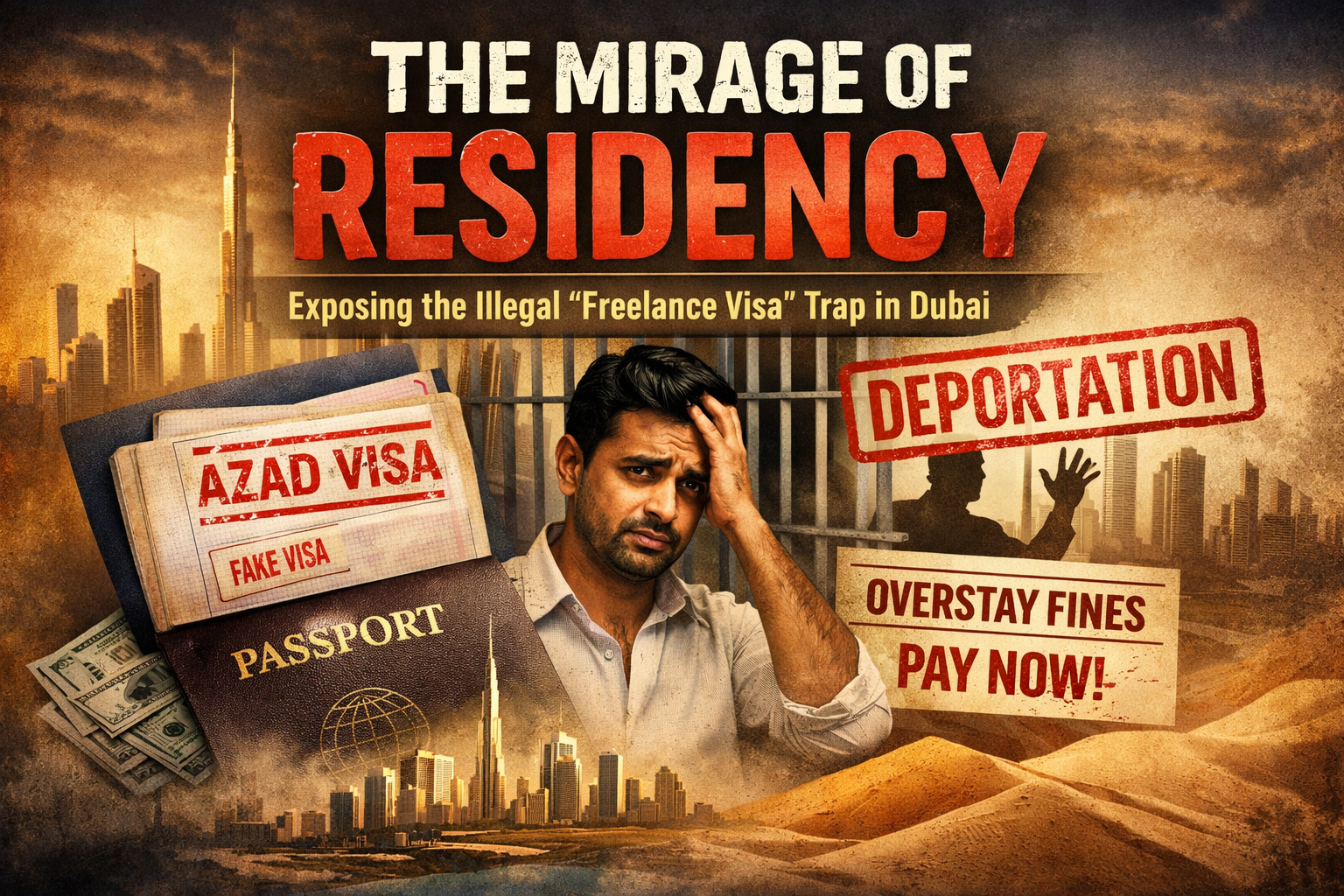
The Mirage of Residency: Exposing the Illegal "Freelance Visa" Trap in Dubai
Dubai represents a beacon of economic opportunity, attracting talent from every corner of the globe. However, this high demand has birthed a shadow economy: the sale of illegal "employment visas" marketed as "Azad" (Free) or "Freelance" visas.
While the UAE government has introduced robust, legal freelance pathways in recent years, a black market persists, preying on the uninformed and the desperate. This blog exposes the mechanics of this fraud, the devastating human cost, and how to navigate the system legally.
The Core Deception: What is an Illegal "Azad" Visa?
It is crucial to understand the terminology. There is no such legal term as an "Azad" (Free) visa in UAE labor law.
In this scheme, a "shell" company (or a company selling its excess visa quota) sponsors an individual's residency visa. On paper, the individual is an employee of that company. In reality, they pay the company for the visa and work elsewhere (or freelance) without the sponsor’s supervision.
Why is this illegal?
- Circumvention of Labor Law: It falsifies the employment relationship.
- Work Permit Violations: Working for a third party without a specific temporary work permit is illegal.
- Financial Fraud: The "employee" is paying the "employer" for the visa, which is strictly prohibited by UAE law (the employer must bear visa costs).
The Human Cost: Real Scenarios from the Shadows
Online forums, legal help groups, and social media platforms in the UAE are rife with harrowing stories. While names have been anonymized for privacy, these scenarios represent the factual struggles of thousands.
Case Study 1: The "Blocked Company" Nightmare
The Situation: A graphic designer paid AED 9,000 to a "document clearing agent" for a 2-year visa from a construction company. The Outcome: Three months later, the construction company was flagged by the Ministry of Human Resources and Emiratisation (MOHRE) for failing to pay wages to its actual laborers. The company’s trade license was suspended. The designer’s visa was frozen, he could not travel, and he eventually faced huge overstay fines because the company could not process his renewal or cancellation.
Case Study 2: The "Absconding" Blackmail
The Situation: An IT professional bought a visa to stay in Dubai while looking for a permanent job. The Outcome: When she found a legitimate job and asked the sponsor to cancel her visa so she could switch, the sponsor demanded an "exit fee" of AED 5,000. When she refused, the sponsor filed a false "Absconding" (runaway) report against her. This leads to an immediate ban on employment and potential deportation, leaving the victim with no leverage but to pay the extortion money.
Case Study 3: The Airport Shock
The Situation: A freelancer traveled home for a holiday. The Outcome: Upon returning to DXB airport, they were denied entry. The shell company they were "employed" by had shut down and cancelled all visas while the holder was abroad to avoid labor inspections. The individual lost their residency, their rented apartment contents, and their bank account access overnight.
Anatomy of the Fraudulent Market
The market for these visas operates largely on social media platforms like TikTok, Facebook, and Instagram, often targeting low-to-mid-income workers.
How it Works:
- The Shell Game: Fraudsters set up companies with no physical office or genuine business activity. They obtain a visa quota (e.g., 50 visas).
- The Sale: They sell these slots for AED 7,000 to AED 15,000.
- The "NOC" Trap: They promise a No Objection Certificate (NOC) allowing you to work elsewhere. Reality Check: An NOC from a private company does not override UAE Labor Law regarding working for others without a Ministry permit.
The Risks involved:
- Immediate Deportation: If caught working for a company other than your sponsor during an inspection.
- Lifetime Ban: Permanent bans from entering the UAE are common for serious labor violations.
- Financial Ruin: Loss of the initial payment, plus fines that accrue daily.
The Authorities' Stance: Vigilance and Crackdown
The UAE authorities, specifically MOHRE and the ICP (Federal Authority for Identity, Citizenship, Customs & Port Security), have adopted a zero-tolerance policy.
- Emiratisation Scrutiny: With the push for NAFIS (Emiratisation targets), companies are under heavy scrutiny. Shell companies selling visas distort these numbers and are being rapidly shut down.
- Digital Integration: The Wage Protection System (WPS) monitors if "employees" are being paid salary. If a person is on an "Azad" visa, there is no salary transfer. Authorities use this data gap to identify and flag fake employment.
- Heavy Penalties:
- For the Seller: Fines ranging from AED 100,000 to AED 1,000,000 for fake Emiratisation or visa trading.
- For the Buyer: Deportation and fines.
The Solution: Legal Pathways to Freelance in Dubai
The UAE government recognizes the gig economy and has created legal, secure, and transparent ways to live and work as a freelancer without resorting to the black market.
1. The Green Visa (Self-Employment/Freelance)
This is a game-changer introduced by the UAE government.
- Eligibility: You must have a freelance permit from MOHRE or a degree/diploma in specific fields.
- Benefit: A 5-year residency without a sponsor. You are your own sponsor.
- Requirement: Proof of income (approx. AED 360,000 over two years) or financial solvency during your stay.
2. Free Zone Freelance Permits
Many Free Zones offer specific freelance packages. These are 100% legal.
- Popular Options:
- GoFreelance (TECOM Group): Covers Dubai Media City, Internet City, and Knowledge Park. Great for tech and media professionals.
- DDA (Dubai Development Authority) Talent Pass.
- RAKEZ (Ras Al Khaimah Economic Zone): Often more affordable, starting around AED 6,000–8,000 for the license (visa fees are separate).
- Twofour54 (Abu Dhabi): Focused on media and gaming.
- Process: You apply for a permit, and based on that permit, you apply for a residency visa.
3. Setting Up a Sole Establishment
If you are generating higher revenue, you can set up a proper company.
- Instant Licenses: Dubai Economy (DED) offers instant licenses for many activities.
- Benefit: You get a trade license and an investor visa, allowing you to legally invoice clients and open corporate bank accounts.
Conclusion: Do Not Risk Your Future
The allure of a "cheap, no-questions-asked" visa is a mirage. The short-term savings are eclipsed by the long-term risk of deportation, blacklisting, and financial loss.
Advice: Always check the legitimacy of a visa offer. If a "company" asks you to pay for your own employment visa, it is a crime. Opt for the legal routes provided by the government—they offer peace of mind, legal protection, and true freedom to work.